
| Mirror’s Edge: Catalyst | |
|---|---|
 | |
| Разработчик |  EA DICE EA DICE |
| Издатель |  Electronic Arts Electronic Arts |
| Локализатор |  EA Russia EA Russia |
| Часть серии | Mirror’s Edge |
| Дата анонса | 10 июня 2013 года |
| Дата выпуска | |
| Лицензия | проприетарная |
| Жанр | приключенческий боевик платформер |
| Возрастной рейтинг | ESRB: T — Teens PEGI: 16 RARS: 18+ |
| Создатели | |
| Руководитель | Эрик Одельдал |
| Продюсер | Сара Янссон |
| Геймдизайнеры | Вияр Соммербакк Эрик Одельдал |
| Композитор | Solar Fields |
| Технические данные | |
| Платформы | |
| Игровой движок | Frostbite 3 |
| Режим игры | однопользовательский |
| Язык интерфейса | Основные языки мира, включая и русский |
| Носитель | оптический диск цифровая дистрибуция |
| Системные требования | Минимальные системные требования — Windows 7 64-битная (с последним Service Pack); — Intel i3-3250 / AMD FX-6350 (игре требуется минимум четыре ядра); — 6 ГБ ОЗУ; — 25 ГБ места на жестком диске; — Nvidia GeForce GTX 650 Ti 2 ГБ и лучше / AMD Radeon R9 270x и лучше. Рекомендуемые системные требования — Windows 10 64-битная (с последним Service Pack); — Intel Core i7-3770 3.4 ГГц / AMD FX-8350 4.0 ГГц; — 16 ГБ ОЗУ; — 25 ГБ места на жестком диске; — Nvidia GeForce GTX 970 4 ГБ и лучше / AMD Radeon R9 280x 3 ГБ и лучше. |
| Управление | геймпад, клавиатура и мышь. |
| Официальный сайт | |
 7 июня 2016 года
  9 июня 2016 года
Mirror’s Edge: Catalyst (с англ. — «Зеркальная Грань: Катализатор») — кроссплатформенная компьютерная игра в жанре приключенческого боевика и платформера от первого лица, разработанная компанией DICE под издательством Electronic Arts для платформ PC (Origin), PlayStation 4 и Xbox One. Является перезапуском игры «Mirror’s Edge» 2008 года. Дебютный анонс состоялся на E3 2013. Релиз игры был запланирован на 23 февраля 2016 года [1] , но сначала перенесён на 24 мая, а затем на 7 июня того же года.
Содержание
История разработки [ править | править код ]

2008—2009 годы [ править | править код ]
В октябре 2008 года старший продюсер EA DICE Оуэн О’Брайан (англ. Owen O’Brien ) в интервью изданию Ausgamers заявил, что Mirror’s Edge является первой частью запланированной трилогии. «История, которую мы собираемся рассказать в Mirror’s Edge, является частью большого повествования, состоящего из трёх актов, — заявил он. — Вначале всё внимание будет уделено Фейт, мы постараемся рассказать максимально подробно о её жизни, о том, как она выживает в этом мире» [2] [3] .
12 июня 2009 года в интервью сайту V >[4] [5] [6] [7] [8] [9] :
Mirror’s Edge была рискованным шагом. Это был смелый шаг — новаторский и очень воодушевляющий. Игра ни в коей мере не была совершенной. Нам хотелось бы, чтобы игра продавалась лучше, хотя её фактические продажи оказались выше, чем большинство людей думает… Вы обязательно увидите ещё одну игру Mirror’s Edge. Вопрос лишь в том, когда и как мы её сделаем.
1 декабря 2009 года игровой прессе стало известно, что Оскар Карлен (англ. Oscar Carlen ), художник по свету в ЕА DICE, в своем портфолио обнародовал информацию о том, что компания занимается разработкой продолжения Mirror’s Edge. Чуть позже Оскар Карлен убрал упоминание о Mirror’s Edge 2 со своего сайта, заменив его фразой «Move along, nothing to see here…» («Идите мимо, здесь не на что смотреть…») [10] [11] [12] .
Утром 2 декабря 2009 года игровой блог Kotaku.com взял, а 3 декабря опубликовал большое интервью с главой Electronic Arts Джоном Ричителло (англ. John Riccitiello ), в котором обсуждалась оригинальная Mirror’s Edge и Mirror’s Edge 2. Ричителло заявил, что считает, что оригинальная игра Mirror’s Edge вполне заслужила право получить продолжение, однако разработчики все ещё далеки от выпуска Mirror’s Edge 2. «Мы все ещё работаем над базовыми элементами Mirror’s Edge 2, думаем, как сделать игру лучше. Мы многому научились, работая над первым проектом, который был, как мне кажется, очень инновационным», — заявил журналистам Ричителло [13] [14] .
2010—2011 года [ править | править код ]
В конце января 2010 года продюсер Battlefield: Bad Company 2 Карл-Магнус Тродссон (англ. Karl-Magnus Troedsson ) отказался комментировать ситуацию о разработке Mirror’s Edge 2: «Я не могу давать ответы на подобные вопросы, потому как мы официально ничего не анонсировали. Безусловно, мы очень гордимся Mirror’s Edge, поэтому мы думаем о будущем этого франчайза» [15] [16] .
В начале ноября 2010 года сайт Eurogamer взял интервью у Патрика Содерлунда, в котором попросил прокомментировать его же заявление июня 2009 года о разработке Mirror’s Edge 2. Содерлунд ответил, что, несмотря на то, что оригинальная Mirror’s Edge не была столь коммерчески успешной, как ожидалось, однако провалом она тоже не стала. Поэтому разработчики «не похоронили» франчайз Mirror’s Edge и планируют его поддерживать в дальнейшем [17] .
7 февраля 2011 года DICE опубликовала новое технологическое видео игрового движка Frostbite 2.0, демонстрирующее графическую технологию «Real-time Radiosity». [18] Первая сцена на данном видео по своему виду напоминает локации оригинальной Mirror’s Edge (общий архитектурный стиль и окраска некоторых объектов в ярко красный цвет), что дало повод некоторым игровым журналистам предположить, что Mirror’s Edge 2 будет использовать Frostbite 2.0 [19] .
В начале июля 2011 года старший вице-президент EA Games Патрик Содерлунд в интервью GameStar заявил, что он очень любит Mirror’s Edge и что разработчики не бросили данную серию. «Мы работаем над кое-чем, однако я не хочу больше говорить на эту тему», — добавил он [20] .
В конце июля 2011 года в журнале «Official U.S. PlayStation Magazine» была опубликована следующая заметка: «Движок Frostbite 2.0 подготовит почву для того, чтобы Mirror’s Edge смогла осуществить своё паркурное возвращение» [21] .
В начале октября 2011 года в интервью SPOnG продюсер DICE Патрик Лиу (англ. Patrick Liu ) говорил о возможном продолжении Mirror’s Edge, заявив, что оно (продолжение) вполне может привлечь внимание бо́льшей аудитории, нежели оригинальная игра. Он подчеркнул, что DICE осведомлена о том, что вокруг Mirror’s Edge сформировалась большая база поклонников, и для некоторых игра стала чем-то вроде культа. «Мы также знаем сильные и слабые стороны оригинальной игры. Если бы мы занимались сиквелом, мы бы точно знали, что нужно улучшить и что изменить, чтобы привлечь внимание гораздо большей аудитории», — сообщил Лиу [22] .
Сообщение об остановке разработки [ править | править код ]
14 февраля 2011 года игровой общественности стало известно об остановке разработки Mirror’s Edge 2. В середине декабря 2010 года Патрик Содерлунд принял участие в шведском телеинтервью «Press2Play». Лишь приблизительно через два месяца, 14 февраля, сайт Eurogamer выполнил перевод отчёта этого интервью и таким образом факты, озвученные в этом интервью, стали известны международной англоязычной игровой общественности [23] . Патрику Содерлунду был задан вопрос о продолжении Mirror’s Edge, и он ещё раз подтвердил, что Mirror’s Edge 2 действительно разрабатывалась, однако также сообщил, что на момент данного интервью разработка игры остановлена, а сотрудники, работавшие над ней, распределены по другим проектам. Согласно Содерлунду, DICE показала прототип игры руководству Electronic Arts, и, ознакомившись с данным прототипом, руководство приняло решение остановить разработку игры. Дополнительным фактором, повлиявшим на остановку разработки, послужили низкие продажи оригинальной игры, которые не выполнили возложенные на неё ожидания [24] [25] [26] . После этого сообщения сайт 1UP.com связался с представителем Electronic Arts, который сообщил сайту, что Mirror’s Edge является важным франчайзом для компании, однако в данный момент DICE работает над «Battlefield 3» и ей нечего анонсировать. [27] [28] 1UP.com выразил своё недоумение по поводу данного сообщения [29] .
Сообщение от Фрэнка Жибо [ править | править код ]
E3 2011 [ править | править код ]
9 июня 2011 года во время проведения выставки Electronic Entertainment Expo 2011 журналист портала GameTrailers Джеф Кейли (англ. Geoff Keighley ) взял интервью у президента EA Games Фрэнка Жибо. В этом интервью, помимо всего прочего, Кейли спросил о Mirror’s Edge 2, на что Жибо во второй раз подтвердил, что игра не отменена, однако «сейчас мы активно ищем правильный способ вернуть франчайз на рынок». Согласно Жибо, для Mirror’s Edge 2 нужны новые интересные идеи и DICE работает над их созданием. На это утверждение Кейли отметил, что он бы хотел увидеть игру на движке Frostbite 2.0, на что Жибо, в свою очередь, ответил: «Вы увидите эту комбинацию, я уверен». [33] [34]
2012 год [ править | править код ]
В середине мая 2012 года сразу в нескольких резюме появилась информация о том, что разные специалисты работали/работают над игрой Mirror’s Edge 2 [35] .
В июле 2012 года Фрэнк Жибо в одном из интервью сообщил, что игра не сброшена со счетов, она есть в списке игр, над которыми издатель будет работать, но на текущий момент никаких анонсов по данной теме у него нет. Основной проблемой/задачей Фрэнк назвал определение того, как главная героиня вернётся во вторую часть, видимо имеется в виду развитие геймплея и увеличение интерактивности в игре [36] .
В ноябре 2012 года Бен Казинс, экс-директор Battlefield, подтвердил, что Mirror’s Edge 2 разрабатывается компанией EA Digital Illusions CE [37] .
2013 год [ править | править код ]
Глава EA Games Фрэнк Жибо (Frank Gibeau) сказал, что на грядущем E3 они собираются показать несколько новых проектов от DICE, EA Sports и BioWare, которые разрабатываются для консолей следующего поколения. Какие именно проекты покажет EA, отчасти было известно, об остальных можно было только догадываться.
За несколько дней до Е3 технический руководитель отдела разработки Frostbite Йохан Андерссон сказал, что «очень сложно забыть о Mirror’s Edge». Зная, как давно поклонники всего мира просят разработчиков выпустить сиквел этой замечательной игры, с большой долей вероятности можно предположить, что всё это не простое совпадение и нам действительно покажут Mirror’s Edge 2, а возможно это что-то по вселенной Star Wars. Ведь, как стало известно, компания EA подписала многолетнее соглашение с Disney, согласно которому студии BioWare, DICE и Visceral займутся разработкой новых игр по вселенной Star Wars.
В ночь перед E3 (10 июня), EA Games после показа мультиплеера Battlefield 4, сделала ранее обещанный «сюрприз», этим сюрпризом оказался показ геймплейного ролика и анонс Mirror’s Edge 2. Предварительная дата выхода пока не разглашалась. Также как и Battlefield 4, игра будет базироваться на движке Frostbite 3.0
Согласно заявлению EA новый Mirror’s Edge будет игрой с открытым миром, об этом заявил президент торговой марки Electronic Arts Фрэнк Жибо, охарактеризовав жанр как «open-world action adventure».
2014 год [ править | править код ]
По неофициальным данным игра создаётся для платформ PC, PlayStation 4 и Xbox One. Информация о доступности игры для консолей нового поколения подтверждена в конце июня 2013 года [38] .
Среди нововведений перечисляется более расширенный арсенал приёмов рукопашного боя, открытый мир, несколько многопользовательских режимов [39] .
Игровая механика прототипа Mirror’s Edge продемонстрирована 9 июня 2014 года в ходе пресс-конференции Electronic Arts в рамках выставки E3 2014 [40] .
2015 год [ править | править код ]
В мае 2015 года стало известно, что релиз перезапуска Mirror’s Edge назначен на первую четверть 2016 года [41] . Позднее игра получила подзаголовок «Catalyst» (с англ. — «Катализатор»), чтобы подчеркнуть, что новый проект не является продолжением предыдущей игры [42] . На выставке «E3 2015» с выходом геймплейного трейлера объявили, что релиз игры состоится 23 февраля 2016 [1] . Тогда же стали известны и некоторые подробности игры:
- Действие игры развернётся в «Городе Зеркал» (англ. The City of Glass ), представляющем собой обещанный ранее открытый мир, свободный для исследования. Как и в предыдущей игре серии, в городе присутствует тотальный контроль информации и слежка за всеми жителями, официально — для обеспечения их безопасности и безопасности всего города. Однако в новой части игры контроль осуществляется не официальными городскими властями, а корпорацией «Конгломерат».
- В игре будет присутствовать знакомое по предыдущей части «зрение бегущего» — цветовое выделение объектов, с которыми игрок может взаимодействовать.
- Изменилась механика боёв. Теперь Фейт не может использовать огнестрельное оружие, но намного эффективнее сражается врукопашную.
- В игре будут присутствовать как основные, так и второстепенные задания.
По сообщению игрового портала Game Media Entertainment, в конце октября 2015 года старший продюсер игры Сара Янссон сообщила, что дата выхода «Mirror’s Edge: Catalyst» перенесена на 24 мая 2016 года в связи с доработкой игры [43] .
2016 год [ править | править код ]
В конце апреля 2016 года компания DICE сообщила о переносе релиза на 9 июня в европейских странах, и на 7 июня для Северной Америки. Руководитель дизайна игры Эрик Оделдал сообщил, что перенос связан с желанием разработчиков как можно более плотно поработать с отзывами игроков по итогам закрытого бета-тестирования, стартовавшего 22 апреля.
| Mirror’s Edge: Catalyst | |
|---|---|
 | |
| Разработчик | DICE |
| Издатель | Electronic Arts |
| Дата выпуска | Северная Америка: 24 мая 2016 |
Европа:
24 мая 2016
Россия:
24 мая 2016
платформер
Xbox One
PC
DVD
Цифровая дистрибуция Origin
Mirror’s Edge: Catalyst (рус. «Зеркальная грань: Катализатор») — мультиплатформенная компьютерная игра в жанре action-adventure, разработанная студией EA Digital Illusions CE. Игра повествует о новой истории Фейт.
Игра была выпущена для PlayStation 4, Xbox One и ПК 7 июня 2016 года в США и 9 июня в Европе. Игра основывается на движке Frostbite 3.
Разработка Править
Сценарист предыдущей игры Mirror’s Edge, Рианна Пратчетт, больше не участвует в разработке. Ведущий продюсер игры — Сара Дженсон.
Игра была анонсирована 10 июня 2013 года на E3. До этого момента игра носила название Mirror’s Edge. Игровой прототип был продемонстрирован 9 июня 2014 года на E3. 9 июня 2015 года DICE сообщили об переименование игры в Mirror’s Edge: Catalyst, опубликовали геймплейный ролик и дату релиза на E3.
Стоит заметить, что игра была не лучше своей прошлой части из-за нового продюсера. Игра потеряла фишки и в итоге резко сменила стиль. Скорее причины изменения стиля экономические — над первой частью работали люди из Японии, после аварии на АЭС "Фукусима-1" и спадом экономического положения в Японии Японцы покинули проект. Вторая часть лишилась Японской архитектуры.
| Mirror’s Edge Catalyst | |
|---|---|
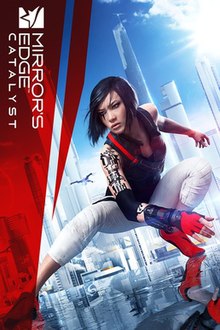 | |
| Developer(s) | EA DICE |
| Publisher(s) | Electronic Arts |
| Director(s) | Per Juhlén |
| Producer(s) | Sara Jansson |
| Designer(s) | Erik Odeldahl |
| Artist(s) | Jhony Ljungstedt |
| Writer(s) | Christofer Emgård |
| Composer(s) | Solar Fields [1] |
| Engine | Frostbite 3 |
| Platform(s) | Microsoft Windows PlayStation 4 Xbox One |
| Release | |
- NA: June 7, 2016
- EU: June 9, 2016
Mirror’s Edge Catalyst received mixed to positive reviews from critics upon release, with most reviewers praising the free-running gameplay and visuals, but criticizing the story and combat.
Contents
Gameplay [ edit ]
Mirror’s Edge Catalyst is a first-person action-adventure game in which the player takes control of Faith Connors as she progresses through a futuristic city named Glass. Similar to the original Mirror’s Edge, players traverse the city using aspects of urban exploration and parkour movements to complete missions and evade or fight enemies. Players can also make use of environmental objects such as zip-lines and ledges, and equipment; this includes a MAG (Manifold Attachment Gear) Rope and a Disruptor [3] to travel across buildings, disable certain systems (such as large fans or security cameras) and a >[4] The use of levels and linear gameplay found in the first Mirror’s Edge has been replaced with an open world, free-roaming environment. This gives players more freedom in traversal, allowing for the use of multiple paths to reach one’s objective. [5] In addition to the campaign’s mission, s >[6]
Combat mechanics of the game received an overhaul and a new combat system was developed as traversal is greatly emphasized in the game. [5] Also, though only used sparingly in the previous game, Mirror’s Edge Catalyst has removed the use of guns by the player altogether, focusing on Faith’s running and parkour movements and quick melee-style attacks to take down or evade her enemies. [7] Faith enters focus mode while she is running. With sufficient focus Faith can evade bullets from enemies. [3] According to Sara Jansson, the senior producer of the game, the combat and fighting featured is an extension to the game’s movement instead of a separated set. [8] When Faith is performing a finishing move, the game switches to a third-person perspective. [9]
Mirror’s Edge Catalyst contains several multiplayer features, which DICE calls Social Play. [10] While there are no live co-operative multiplayer or s >[11] Among these are Time Trials which, unlike in the 2008 game, are not pre-defined by DICE. Instead, these checkpoint-to-checkpoint paths are set by any player whereby others can race against them at their leisure for faster times. Players are also able to place Beat __cpLocation Emitters for other players to track down, an exploration activity similar to geocaching.
Synopsis [ edit ]
Setting [ edit ]
The game takes place in the dystopian, futuristic city of Glass, the showcase city of the nation of Cascadia, governed by a totalitarian corporatocracy. Cascadian society is highly stratified, and the majority of citizens work for the corporations and are connected to the Grid, a massive social surveillance system digitally connecting everything and everyone in cities like Glass. The corporations are secretly preparing to launch a project, called Reflection, to control the populace through the Grid.
So-called Runners, freelance messengers skilled at free running, refuse to be connected to the Grid and live on rooftops, making their living from covert delivery jobs while evading corporate security. The game centers around a Runner named Faith, and her efforts to help other Runners overthrow the corporate government and stop Reflection.
Plot [ edit ]

Faith Connors is released from prison and meets up with fellow runner Icarus, as well as Runner cabal leader Noah, who raised Faith after the death of her parents. During a data grab inside the headquarters of Elysium, Faith diverges from her orders and retrieves a valuable hard drive, but is seen by Gabriel Kruger, CEO of Kruger Security, or K-Sec. She manages to escape, intending to use the drive’s contents to pay off her debt to Dogen, a black market boss. Noah is angry at Faith for involving herself with Kruger, but tells her that she needs to know what is inside the drive in order to bargain with it. Faith takes the drive to Plastic, a talented hacker, who tells her the drive contains blueprints for a top-secret project known as Reflection.
Meanwhile, K-Sec cracks down hard on the Runners because of Faith’s actions at Elysium. While Icarus and Faith are away, they lead a raid on the Runners’ lair and capture or kill everyone present. Faith and Icarus, having nowhere to go, turn to Rebecca Thane, leader of Black November, a militant resistance movement bent on destroying the Conglomerate by force. The rebels set up an ambush to capture a high-ranking K-Sec commander, whom they intend to trade for their own captured soldiers. The mission is a success and it turns out that the captured officer is Isabel Kruger, daughter and personal bodyguard of Gabriel Kruger.
Faith asks Plastic to infiltrate K-Sec servers and gather information about Isabel, who turns out to be Caitlyn "Cat" Connors, Faith’s own sister, who was assumed dead. Gabriel Kruger took her in as his adoptive daughter, telling her that Faith was killed along with the rest of her family. Faith races back to the subterranean Black November HQ where Thane is preparing to execute Isabel in order to send her father a message. Even though Isabel doesn’t seem to remember who Faith is, Faith convinces Thane to save her.
Isabel lets on to Faith that Noah might still be alive, held in a compound called Kingdom. Upon reaching it, Faith rescues a group of Reflection scientists who were detained by K-Sec for "asking too many questions." The lead scientist, Aline Maera, explains that Reflection involves injecting the population with nanites that can be remote-controlled to regulate thoughts and emotions. Aline also mentions that Faith’s own mother Erika invented the algorithm that would later allow Reflection to be realized. Faith finds Noah who is being experimented on with prototype Reflection nanites, but is too late to prevent his death. Meanwhile, back at Black November HQ, the rebels are ambushed by K-Sec while moving Isabel above ground. Icarus and the rebels are injected with Reflection nanites.
Faith continues to have flashbacks of Gabriel Kruger killing her parents who wanted out of the Reflection project. As Faith and Cat were escaping, a gas grenade was tossed, causing Cat to choke and lose consciousness. Faith was forced to abandon her.
Plastic and Aline work together to engineer a virus to disable Reflection once and for all. In order to do this they need Gabriel Kruger’s ID, which Faith secures by breaking into his private apartment. From there she witnesses a massive explosion at The Shard, the tallest building in all of Glass. Faith still needs to go on top of The Shard, which contains the broadcast antenna but is now unstable, to activate the virus. At the top she is confronted by Gabriel who defends his decision to launch Reflection, saying the nanites are a cure designed to keep Isabel’s chronic lung condition at bay, and that the project is about survival rather than control.
They are joined by Isabel who attempts to stop the virus but is too late. They fight on the helipad, and Isabel accuses Faith of leaving her behind to die, while Faith attempts to remind Isabel of who she really is. Gabriel Kruger appears on a helicopter and begs a hesitating Isabel to come with him. The Shard starts to crumble and Gabriel flies out of the tumbling helicopter. Faith slides to the edge of the helipad but is caught by Isabel. Gabriel is heard calling out for his daughter to save him, and Isabel explains to Faith that she "has to" and runs off in his direction. However, as the helicopter rises again and flies away, only Isabel is standing in it, with Gabriel nowhere to be seen.
In the aftermath, it is reported on the news that Isabel will now supersede her missing father as Kruger Security CEO. While there was no uprising in the population, Faith did successfully disable the Reflection launch, thus keeping people safe from Conglomerate control.
Development [ edit ]
The new Mirror’s Edge game was officially revealed in June 2013 at the Electronic Arts press event at Electronic Entertainment Expo 2013. It was released for Microsoft Windows, PlayStation 4, and Xbox One in North America on June 7, 2016, and in Europe on June 9. [12] The game was announced soon after as a prequel to Mirror’s Edge showcasing the origins of Faith, [13] and uses the Frostbite engine, [14] instead of the Unreal Engine used in the first game. However, at a later date Sara Jansson stated that the game was not seen as either a reboot or a prequel. [5] Electronic Arts also confirmed in 2013 that the game would be an "open-world action adventure". [15] According to DICE’s general manager Karl Magnus Troedsson, the game focuses on the first-person combat mechanics building upon the first-person movement mechanics that were present in the first game. [16] As the game features a free-roaming environment, the runner vision from the first game had been completely redesigned to adapt this structure. The runner vision in Catalyst can recalculate the path for players towards their objectives or waypoints. [17]
The game was featured at E3 for a second time in June 2014, and prototype gameplay was briefly shown. Mirror’s Edge Catalyst has more varied gameplay for Faith and Runners, where they serve a greater purpose than in the first game. [18] In January 2014, writer Rhianna Pratchett announced on Twitter that she would not be involved with the new game and neither would most of the original team. [19] Mirror’s Edge was confirmed to have a planned release date of February 23, 2016 before it was delayed. [20]
The title Mirror’s Edge Catalyst was formally announced in June 2015 prior to E3 2015; DICE product manager Sara Jansson affirmed that the game is not a sequel but would delve into more of Faith’s past while expanding on the original game’s first-person perspective experience. [21] On June 15, at E3, and later on the Mirror’s Edge YouTube channel, DICE released a new trailer for Mirror’s Edge Catalyst, revealing elements of the game’s storyline and environment. [22] It was confirmed that the game would feature an open-world design and Faith would no longer be able to use guns. [23]
On September 30, 2015, it was announced that the soundtrack composer for the original Mirror’s Edge, Solar Fields would again compose for Catalyst. [24] He collaborated with Scottish synthpop band Chvrches to create an original song for the game’s soundtrack entitled "Warning Call". [25]
On October 29, 2015, it was announced that the game had been delayed until May 24, 2016 to allow additional development time and for DICE to refine the traversal gameplay. [26] [27] On April 21, 2016, it was announced that the game had been delayed until June 7, 2016, to allow optimization and perfection of Social Play. [28] The game’s Collector Edition was released alongs >[29]
A prequel comic book called Mirror’s Edge: Exordium, leading towards the storyline of Mirror’s Edge Catalyst, was published on September 9, 2015, by Dark Horse Comics. [30]
Reception [ edit ]
The game was the second best-selling retail game in the UK in its first week of release, only behind Overwatch. [43] In its second week of release, the game became the sixth best-selling retail game of the week. [44]
According to review aggregation website Metacritic, Mirror’s Edge Catalyst received "mixed or average" reviews from critics. Chris Carter from Destructo >[31]
While citing the movement system as a positive and the combat mechanics as a negative, Spencer Campbell concluded his review for Electronic Gaming Monthly with: "Mirror’s Edge Catalyst has a strong core built by its movement system, but when it comes time to do anything else than run from point A to point B, you’ll probably be more inclined to run away." [32]
Game Informer ‘ s Ben Reeves summarized his review with: "The original Mirror’s Edge is an overlooked gem from last generation, but even diehard fans will have trouble finding the diamonds in this rough." Reeves disliked the design of the game’s environments, calling them "barren" and "lifeless", criticized the melee combat for feeling like a chore, stated that the soundtrack lacked defining characteristics, called the main story "rushed", and felt that the s >[33]
Game Revolution’s Peter Paras called the game’s environments "gorgeous" and "unique", commended the large amount of content, and praised the visuals of the cutscenes. Paras thought that the gameplay was "unintuitive" and "clunky", however, and hated the story and characters. Paras also experienced some technical issues, thought that character animations were "poor", and sa >[34]
Scott Butterworth of GameSpot gave particular praise to the movement mechanics, saying that they consistently wowed him throughout the entire game and made up for the various shortcomings he experienced. Butterworth also liked the varied mix of s >[35]
GamesRadar’s Leon Hurley stated: "Mirror’s Edge Catalyst is an interesting game with some strong >[36] Ryan McCaffrey for IGN summarized his review with: "Mirror’s Edge ‘ s return shines in some regards, but is ultimately a disappointment." McCaffrey complimented the user-generated content and parkour gameplay but criticized the story and characters, as well as the "uneven" combat and inconsistent visuals. [37]
Arthur Gies of Polygon wrote: "I imagine most players will happily bounce from s >[39]


